A Mad Female Bolshevik
Alexandra Kollontai was one of the leading feminists within the socialist movement of Russia. Throughout her life she pushed for women’s rights as well as the rights of workers everywhere from Sweden to The United States of America. Much of Kollontai’s journey is documented throughout her works as well as an autobiography “The Autobiography of a Sexually Emancipated Communist Woman”.
Although she was such a leading role in the male dominated space of the leftist movements of the last 1910s and early 1920s, she managed to maintain a refusal to back down of being both her own person and a woman. Kollontai displays a journey of discovery for both her own personal intimate life as well as a fervor to right injustices and displays the integrity required to achieve it. To the rise of fascism at the end of the first world-war, Alexandra Kollontai represented the opposite of what the fascists wished for a woman to be. A communist, unowned, and intelligent woman who represented all of the threats the new shaky regimes wished to squash out of society.
Rebelling Against the Status Quo
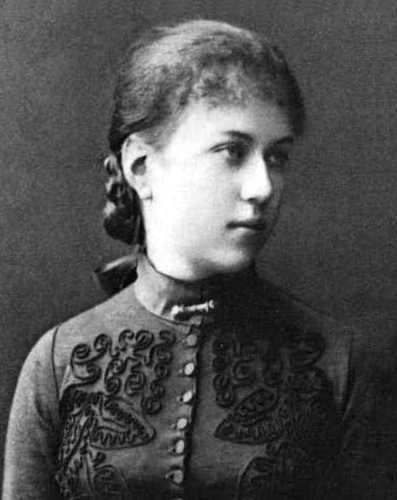
A portrait of Kollontai painted in 1888.
Alexandra Kollontai was born Alexandra Domontovich to her parents who were apart of the old Russian Nobility. She was the youngest and subsequently the most spoiled of her siblings and although her family. When Kollontai wrote of her family’s financial being she described her parents as ‘well-to-do’ and “no luxury in the house” but she did not know the meaning of ‘privation’.
Even with this privileged upbringing Kollontai still recounts a sense of rebelling against injustices throughout her childhood. Although she had begun to witness these differences between how she was treated and other children her exposure to these injustices stayed limited due to her being homeschooled as opposed to being sent off to school.
Kollontai’s mother in fear for both Kollontai’s health and ‘liberal influences’ kept Kollontai home and under the tutelage of Madame Marie Strakhova; a tutor who had connections with revolutionary circles in Russia. Under the tutelage of Madame Strakhova, Kollontai was able to take the qualifying examinations to gain admittance into university when she was only sixteen. After this beginning of Kollontai’s freedom her rebellion continued against the social norms she was expected to uphold. Her first major rebellion would be against her parents wishes of an arranged marriage.
The Desires of the Heart
To write about Alexandra Kollontai and her achievements without mention of her most numerous written topic of love and the desire of it is a fruitless effort. Kollontai’s numerous works dive into every aspect of the idea of marriage, love, and what place these institutions and feelings have within the revolutionary’s mind as well as the society being built. Kollontai’s first love was according to her ‘out of a great passion’ and ‘against her parents’ wishes’. This first love of Kollontai’s was her cousin, and whom she had her only son as well as the last name she kept to the end of her life. This first marriage was a formative experience when it came to Kollontai’s views on love and relationships with how they related to both the liberation of women and workers in general.
Within Kollontai’s ‘Sexual Relations and the Class Struggle’ she examines what she refers to as the ‘sexual problem’. Similar to many of her writings Kollontai focuses on specific social issues that she considers needing solved in the creation of the new society that the new Soviet Union experiment was creating. Within ‘Sexual Relations and the Class Struggle’ Kollontai half examines where old bourgeoisie ideas of individuality may belong within a communist society and half vents on her issues with modern day relationships. The entire article feels extremely personal and resembling a conversation with Kollontai herself. Kollontai identifies two main causes for this sexual crisis:
The idea of ‘possessing’ the married partner;
The belief that the two sexes are unequal, that they are of unequal worth in every way, in every sphere, including the sexual sphere.
Kollontai describes these two reasons as the main issue stemming from the psychology of modern man. These two points that Kollontai argues are direct issues that must be addressed is in stark contrast to Fascism and Nazism where they are both integral to holding them together and ensuring that men know they are better and worth more.
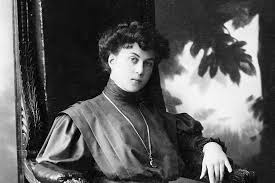
Kollontai.
Kollontai also goes into a half page portion where she writes on how when two people enter a relationship they become insensitive to ‘a third person’. Within this portion Kollontai goes into the idea of two new lovers quickly decide what was once theirs becomes each other’s and put themselves between each other’s business that before had not involved them.
Kollontai also discusses the idea of possessing not just a partners physical faithfulness, but an emotional one as well; this idea of emotional faithfulness she determines to be a new creation with the system of capitalism. These writing can be seen as a reflection of Kollontai’s personal experience. Within her life she had left her first husband due to his feeling that her move to committing more towards the revolutionary movement was a betrayal to him. All that this caused in her however was a new conviction to place her work first and all else second.
Committed Body and Mind
From the moment Kollontai joined the revolutionary movement to her death she worked. The amount of work she accomplished is staggering as she places it first above all else and with the never-ending struggle of liberation of workers worldwide, she had a task in front of her that would never have a deadline. Kollontai’s eye-opening experience was to the Krengolm textile factory.
This was her first view of what the lives of the working populace in Russia was like and how dreadful it was compared to her relatively privileged upbringing and current life. However when she did join the first revolutionary movement she came to a realization of how little women’s rights were cared about. With this realization she simply worked harder and more. She wrote political writings and becoming an extremely popular speaker.
Eventually her writings and speeches caught up to her and she was forced to flee Russia due to the police attempting to arrest her. During this time she lived throughout Europe as well as America until Czarism was overthrown. Even though she was now away from her home, with her son in tow she continued her work. She helped with different communist and socialist groups within the countries she lived in during this time all the while still writing for different illegal and legal publications in Russia.
The Threat of Freedom
Within both fascist Italy, fascist Spain, and nazi Germany one major theme present is that of control. For the entire country the control of ideas is important. Through propaganda the idea of being better and deserving of ownership of both the country and the world is necessary. For women specifically this control goes a step farther to physical. The disallowing of reproductive rights as well as the right to work force women to be financially dependent on men. The restriction of marriage also controls the population even further.
Alexandra Kollontai then represents what these ideologies would see as the opposite of their ideal woman. Kollontai wrote about and refused to bend to the male dominance so many tried to impose on her; that “male” dominance being integral for fascism. She refused to bend to the will of others and is the perfect representation of antifascism as an ingrained behavior and not a choice that must be consciously made.
Kollontai, even before fascism had begun its spread, lived a life resisting it and the roots it grew from. That is why Kollontai in her representation of a free and emancipated woman is such a threat to fascism as a thought and women like her had to be removed or subjugated in these countries before fascism could truly take.
Bibliography: Farnsworth, Beatrice Brodsky. ‘Bolshevism, the Woman Question, and Aleksandra Kollontai.’ The American Historical Review 81, no. 2 (April 1976): 292. https://doi.org/10.2307/1851172.
Kollontai, Alexandra. ‘Sexual Relations and the Class Struggle,’ Translated by Alix Holt, 1921. https://www.marxists.org/archive/kollonta/1921/sex-class-struggle.htm.
Kollontai, Alexandra The Autobiography of a Sexually Emancipated Communist Woman. Translated by Salvator Attansio, 2001. https://www.marxists.org/archive/kollonta/1926/autobiography.htm.
Kollontai, Alexandra . ‘Communism and the Family.’ Translated by Alix Holt, www.marxists.org, 1920. https://www.marxists.org/archive/kollonta/1920/communism-family.htm.