Maria Terwiel
Maria Terwiel was born to Johannes and Rosa Terwiel in 1910. She was born in Boppard, near the Rhine and the French border. She was raised with two siblings, Gerd and Ursula. Her family later moved to Stettin, where her father worked as a civil servant.
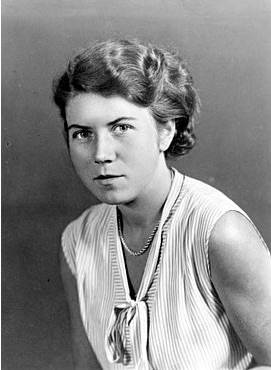
Maria Terwiel. Via Wikipedia.
She graduated secondary school here, later going on to study law at the University of Freiburg. She met her fiancé, Helmut Himpel, at university. Studying financial law, she was due to graduate under her dissertation “Die Allgemeinen Geschäftsbedingungen der Banken, insbesondere die Pfandklaus” in 1935.
In 1933, when the Nazi party seized power, her father was removed from his role due to SPD party membership. Her father Johannes was Catholic and Prussian, while her mother Rosa was Jewish. This classified Terwiel as half-Jewish, and therefore unable to continue her studies, or marry Himpel.
Instead of a law career, she became a secretary at a textile company. When she got engaged to Himpel in 1940, they lived together as fiancés in Berlin, and Himpel was considered her family’s son-in-law. He worked as a dentist, and a connection through a patient of his let them join the Red Orchestra.
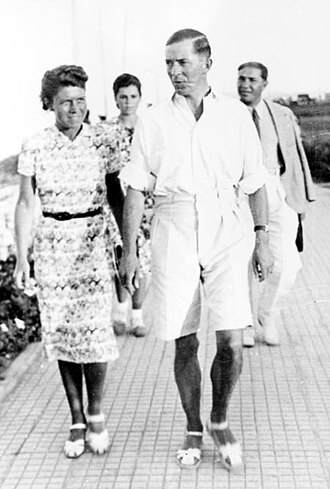
Maria Terwiel and her fiancé, Helmut Himpel. Via Wikipedia
The Red Orchestra - Rote Kappelle
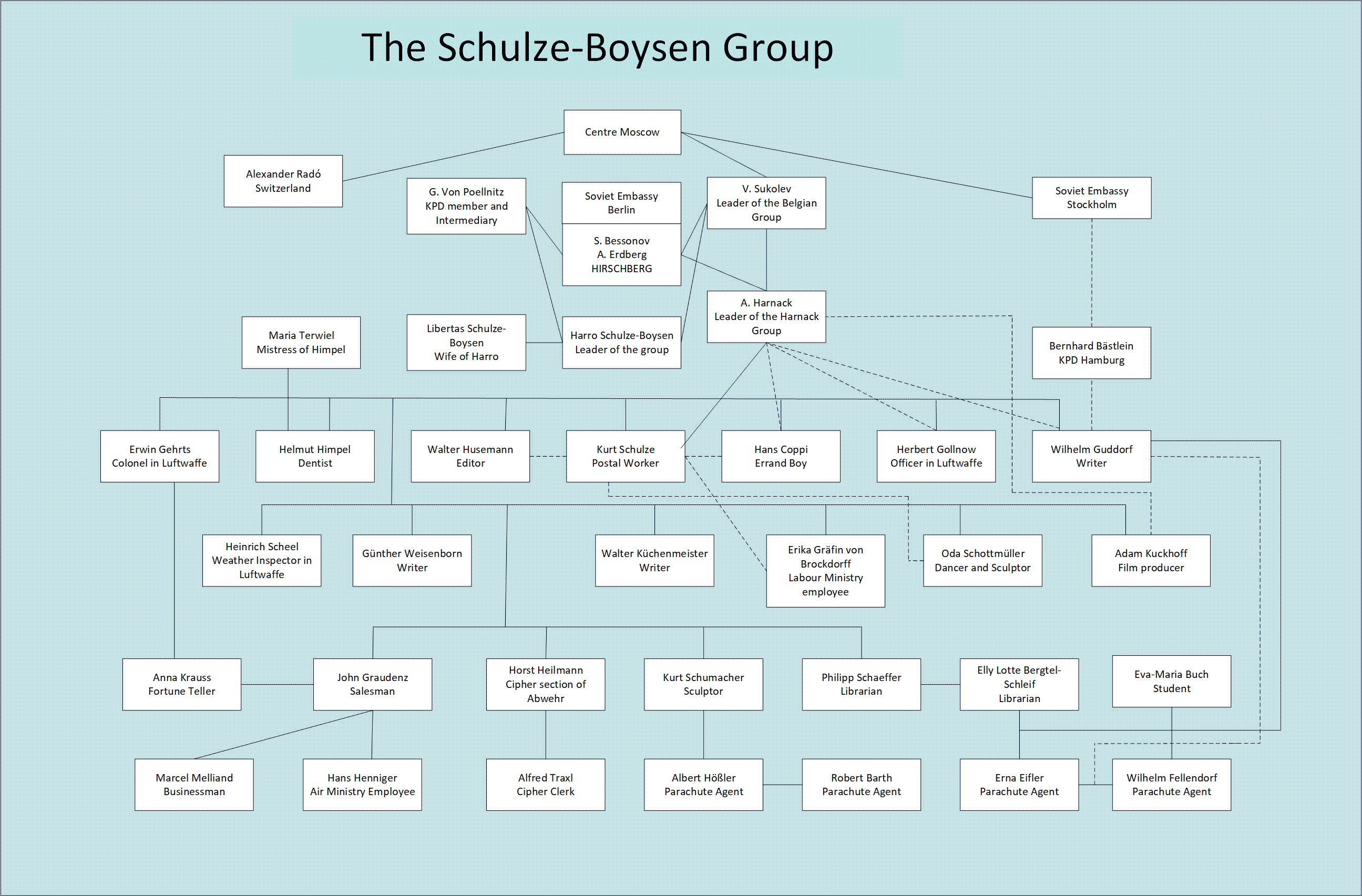
Find Terwiel in the top left of this graph.
The Red Orchestra is the Gestapo name for several groups of socialist-allied resistance groups operating in Berlin. Sometimes called the Schulze-Boysen group, Terwiel and Himpel operated under this framework from 1940 to 1942. This group was known for distributing leaflets of information on crimes and political information on the Nazi party.
The Red Orchestra had two notable factors distinguishing it from other organizations operating in the same area: not all members knew the extent of the group, and women played an active part in the group. The organization was several loose circles of associates, not a tightly defined group. Led by Harro and Libertas Schulze-Boysen, the group consisted of several dozen individuals united by antifascist ideology. These people came from all walks of life, and served as part of a much larger network. The second notable portion of this group is the gender equality found within it’s members. In the case of the Schulze-Boysen’s, both Harro and Libertas had an active role in the resistance, and much of the group was made up of women.
They passed on information to the Soviet Union, part of the reason for the “red” part of their nickname. It also appears like the group was partially funded by the Soviet Union and other socialist channels. In 1942, most of the group was discovered by the Gestapo. Estimate vary, but most active members in this group were executed under the crime of treason or espionage.
Terwiel’s Role
Terwiel played an active role in resistance in the Schulze-Boysen group. In her job as a secretary, she typed up and distributed sermons of Bishop von Galen of Münster. Additionally, she helped paste and distribute flyers with antifascist values on them. Her fiancé also played an essential role in the resistance effort. As part of the Schulze-Boysen group, he treated Jewish patients for free. Additionally, he aided Terwiel in distributing flyers. They also helped provide ration cards and false identification for Jewish people in the area.
Terwiel was arrested and tried for treason and “aiding the enemy in” 1942. She was sentenced to execution, and made a petition for clemency. The rejection of this petition was signed personally by Hitler. Letters from the time indicate she also advised some fellow prisoners how to apply for clemency, and legal arguments to make. She was executed by guillotine in 1943 at the age of 33. During the time between her sentencing and her execution, Himpel was executed under the same crimes.
Memory
The memory of this organization hasn’t been stagnant. Because of the communist ties of this organization, perceptions and memories were not originally as positive. Additionally, the memory of Maria Terwiel is partially clouded by her unmarried relationship to Himpel. While she was an antifascist in her own right, in some cases her role in the group is defined as “Mistress to Himpel,” uncharitably painting her impact as minimal.
Sources and More Information German Resistance Memorial Center. “GDW-Berlin: Biographie Maria Terwiel.” Gdw-berlin.de, 2026. https://www.gdw-berlin.de/en/recess/biographies/index-of-persons/biographie/view-bio/maria-terwiel/?no_cache=1. German Resistance Memorial Center. “GDW-Berlin: The Red Orchestra.” Gdw-berlin.de, 2025. https://www.gdw-berlin.de/en/recess/topics/14-the-red-orchestra. Hennig, Joachim. “012 Maria Terwiel (Member of the ‘Red Orchestra’ from Boppard).” Koblinz Memorial, 2021. https://web.archive.org/web/20230427185614/https://web25.otto.kundenserver42.de/Mahnmal_NEU/index.php/2013-12-12-02-07-02/die-lesemappen/296-012-maria-terwiel-mitglied-der-roten-kapelle-aus-boppard. Tuchel, Johannes. “Weltanschauliche Motivationen in Der Harnack/Schulze-Boysen-Organisation: („Rote Kapelle“).” Kirchliche Zeitgeschichte 1, no. 2 (1988): 267–92. http://www.jstor.org/stable/43750615. Trumpold, Julia. “Book Review: Red Orchestra: The Story of the Berlin Underground and the Circle of Friends Who Resisted Hitler, Revised Edition. By Anne Nelson.” Peace & Change 49 (February 2024): 287–89. https://doi.org/10.1111/pech.12666. Wikipedia Contributors. “Maria Terwiel.” Wikipedia. Wikimedia Foundation, April 1, 2026. https://en.wikipedia.org/wiki/Maria_Terwiel. Yager, Jane. “Silencing the Red Orchestra: Restoring a group to their rightful place in the memory of resistance.” TLS. Times Literary Supplement, no. 6148 (2021): 20+.